
Why Race Matters
Race, or better yet ethnicity matters when it comes to finding a matching donor. Searching patients are most likely to find the best match within their own race or ethnicity. By increasing the diversity of the Be The Match Registry(SM) we can have a positive impact on these figures so that more patients are able to find matching donors.

- Above is an updated chart on the Be The Match website (bethematch.org) in 2019 with the latest data.
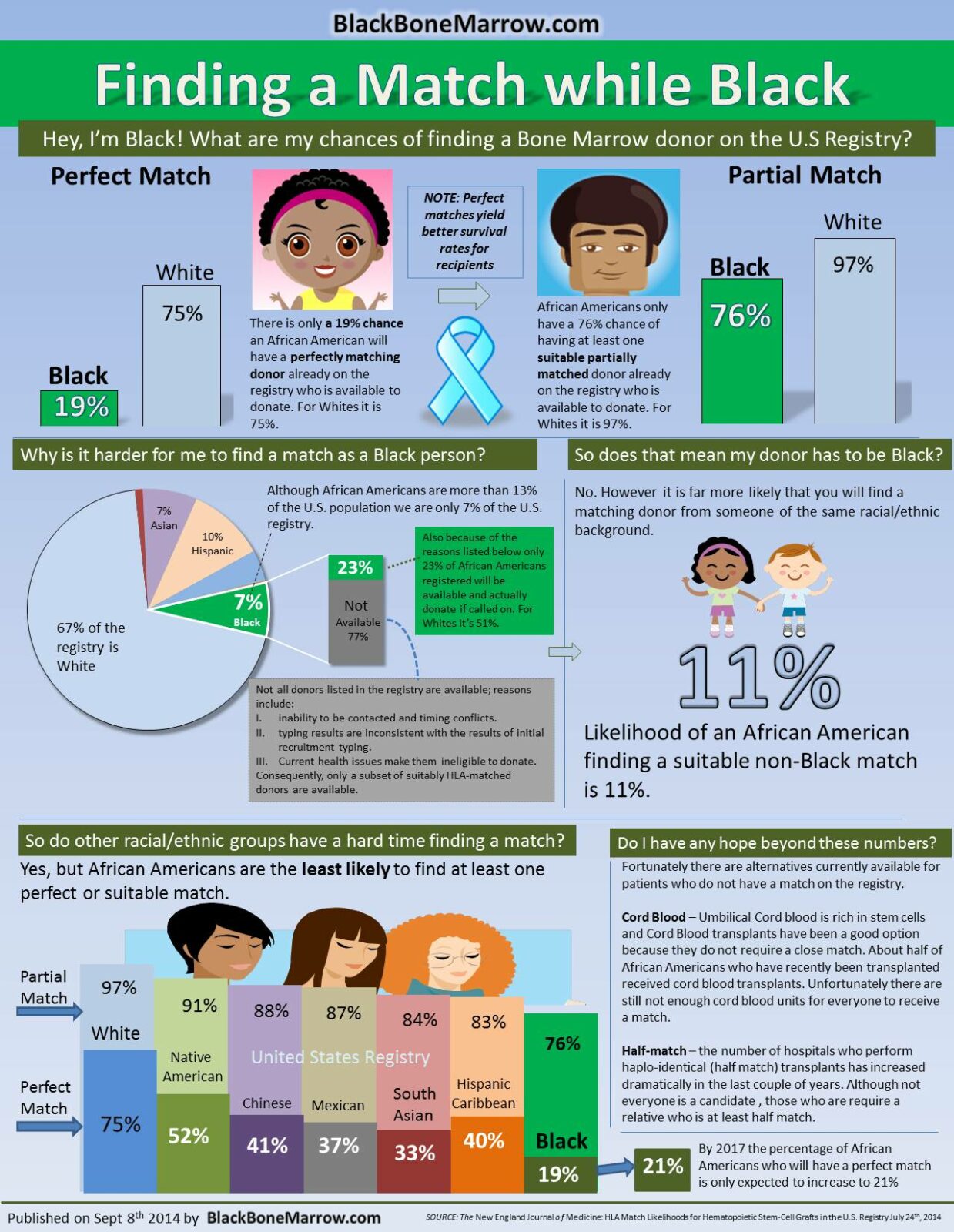
- Below that is an infographic created by BlackBoneMarrow.com in 2014 using data calculated and published from the The New England Journal of Medicine in July 2014. It does a good job of explaining the data in some detail.
The Disturbing Facts
- Compared to other race groups, African Americans are least likely to find at least one potential match.
- African Americans only have a estimated 76% likelihood of having at least one partially matched donor on the Be The Match Registry who is willing and able to donate. For Caucasians its 97%
- Even then, in 2010, just under 4 out of 10 patients of all ethnic groups in the U.S. received the unrelated transplant* they needed. This is referring to receiving transplants, not finding matches. .
- In addition to not having a matched donor or cord blood unit, barriers to transplant include lack of access to health care, no or limited insurance coverage, lack of timely referral for transplant, and decline in health status.
Why is This?
1. We Are Not Aware
2. We Don’t Trust The System
Even as we make are community aware of the need for donors there are other obstacle we must face. African Americans are difficult to convince that they are needed to join and are harder to locate and convince they need to donate once matched.
3. Genetic Diversity
Africans have a greater overall genetic diversity than other population groups in the world (study). This is because the rest of the world migrated from Africa. However Each continent is a total of only some of Africa’s ethnicities. Certain groups went to Europe and others to Asia and beyond. But all can be found in Africa in addition to groups who never left. This leaves Africa with a greater genetic diversity than the rest of the world combined. Because of this African Americans who are mostly of African decent are more genetically diverse therefore making it even more difficult to find matches.
What makes things even more interesting is the genetic admixture of African Americans because of European ancestry. According to population researchers at Penn State University Department of Anthropology on average African Americans are 17-18% white. This conclusion came from a study using DNA samples from groups of African Americans throughout the US, West Africa, and Europe. Although not as large, many Black Americans have Native American ancestry as well. This admixture from three continents makes it more difficult to match donors and patients. For example ten African American patients will have a lower success rate finding matches in a pool of African American donors than ten Nigerian patients would if were to search a Nigerian pool of donors of the same size.

Comments are closed, but trackbacks and pingbacks are open.